
BEEN THINKIN’ ABOUT… THE END OF THE ROAD. The old road winds down the ridge and down through the holler. In the mountains of the South, “holler” just means “hollow” — like Sleepy Hollow — or, more specifically, “a small valley.” The word comes from the Old English word holh, meaning cave or hole in the ground, and there is something empty about the word as it plays in the back of my mind while a hot Thursday wind tinged with February cold blows hard.
That wind blows down a couple degrees and down the holler and down past an old cannon-wall house, limestone walls two feet thick or more with windows that only watch. A perhaps unprepossessing house until you know a little more about the place. Walls like that were only built for one real reason — to repel cannon fire. Whomever built here was expecting more than just friends coming down the road. The sun continues its sole path across the sky. Shadows lengthen over the lee side of the ridge, the ridge a dark ghost thing of a mountain rife with memories of horseback vigilantes, hoof beats echoing beneath the oaks. It is here that time slows. Here, the Ozarks are abridged. Here, the past is nigh. The winds change, intensify. There will be glittering white frost by morning.
Frame of mind is a strange thing. For some, this place is so far off the beaten path, they’ll never arrive. For others, this is the end of the road — no known worlds beyond this moment in time and space. They might arrive and exclaim, “Why, this is so far down in the hills, I’ve found the real Ozarks!” And never look beyond. Curiosity and self-indulgence rarely share space long.
For many souls since long ago, this place was home. A wide open world stretched out all points everywhere from a very familiar front porch. For folks living further back in the Ozarks, this place was a way station, an open dot on the map, a dot that one traveled to in order to find the wider world all points elsewhere … with city and civilization out on the other side of these mountains, just up the road, just out the holler.
The compass, it is said, spins around and around in the dark Sunk-lands. Sometimes the same happens to the heart when we least expect it.
Cities have fixed centers, middles, and edges. For all the grandeur of a Chicago or a New York, there are clear lines of delineation, beginnings and ends upon which all may agree. Not that way out there. Instead, just a gradual shift to another open road beyond. H.L. Mencken liked to mock the Ozarks, calling Ozarkers something akin to monkeys swinging from branch to branch to get a look at the railroad. Nobody knew how to get under Charles Morrow Wilson’s skin, I suspect, like Mencken. I like to think Baltimore’s favorite turn-of-the-century polemicist mocked that which he feared most. I like to think he found the open road unsettling, too alone with too many thoughts, no fixed center, just fence road and farm rolling away ever on and again. You never really know America until you know this America.
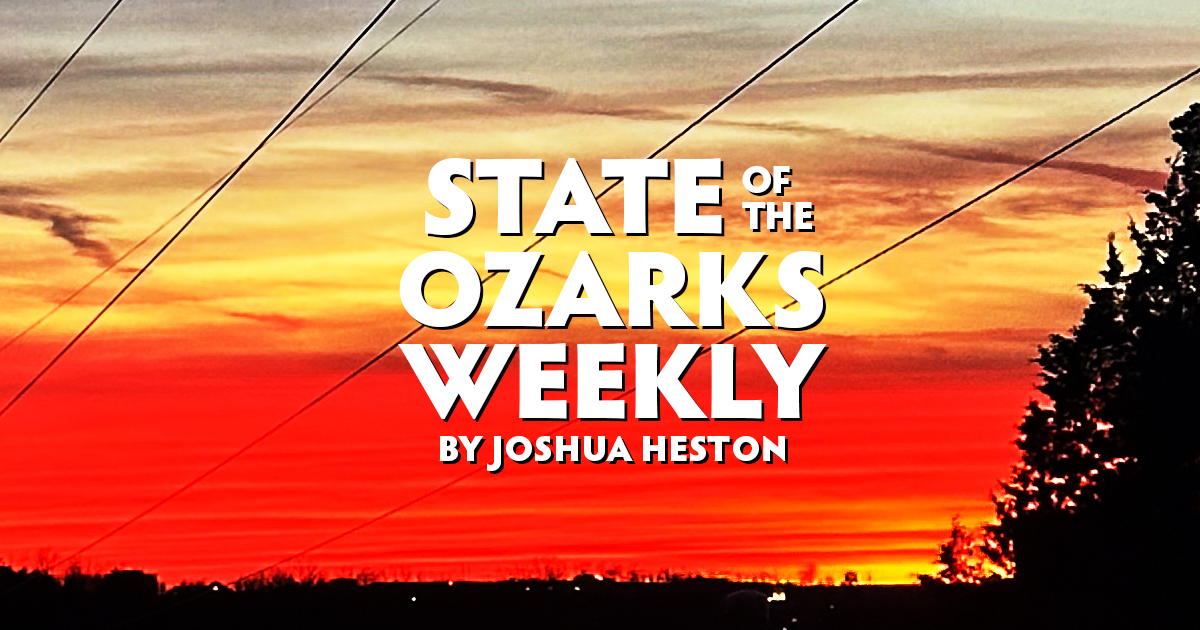
The day’s sky falls, western edge of the world turning to thin crimson and reaching up — a red Dakota sky over old Missouri hill — a reminder the Great Plains lie just over the horizon, ever painting the west the color of blood. The ridge-line is black against the red, echoing other sacred hills, far away across the plains. Above, the twilight blue widens, cradling a hopeful crescent, jewel-like in the night.
Roads — much like days and times and ideas and lives — end in many ways. This world changes so fast. Loss may last only in an instant. The scars a lifetime. Justice can seem far away, nay, even impossible.
The wind is coming fast now, an icy thing biting through thin clothes. Old Glory furls and unfurls violently over the baseball diamond, wind popping the cloth that is now an idea 250 years old. There is fullness in the wind, in its savagery, whispers of natural law and natural law’s inescapability. I smile despite the cold. Justice is not a construct, but instead a holy and sacred thing, vigilante hoof beats on the ridges be damned.
And character is what we do when no one is watching. In the absence of real tenets, the self dissolves, ready and willing to be coagulated into something new, not better. Individuality, justice, stands in the gap, where there is still grit left in a culture, a culture strong enough to stand. A people informs the culture of a land. But the land informs the people. The Ozarks stand often unique, sometimes alone.
I sit in my chair in the warmth, cup of black coffee in one hand, bowl of fruit in the other. I sprinkle cinnamon on my pineapple as it reminds me of home, of old holidays, of making my family recipe for fruitcake. I steady myself with the smell of the cinnamon and fruit. The strangest things form anchors not just to the past but to a foundation — our principles, our sense of self, a reminder of who we are, not what some faceless outside force demands we become. There were cold winds back then too, a million crossroads, a million stories, each one with ends of their own. Truth be told, all stories must end.
But you know what? Nothing ever really ends. Certainly not where there is heart and character in the dark beneath the stars when no one is watching. For no matter how cold and long the night, a new sky is born each morning, again, here at the end of the road.
— Joshua Heston, editor-in-chief, StateoftheOzarks
© StateoftheOzarks 2026