
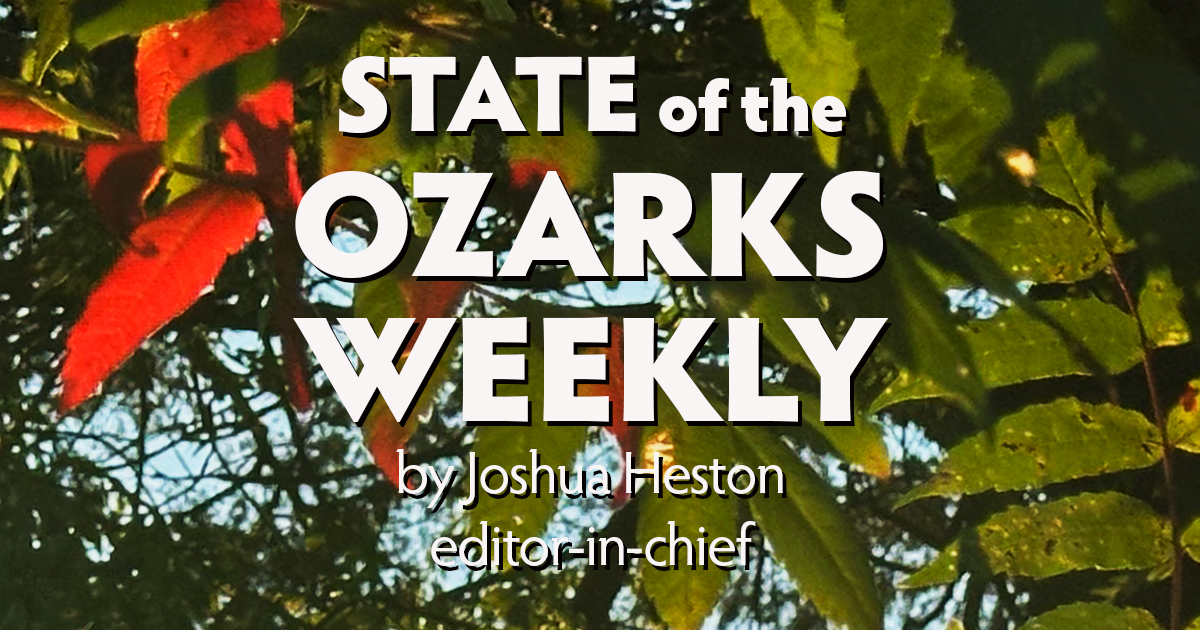
BEEN THINKIN’ ABOUT… OAK & STONE. High on the mountain ridge, last light of the evening sun shines through the red sumac leaves beneath the cedar and oak. Another long day, another hot summer, another farmers market coming to quiet close. Beyond, the sound of traffic, of slamming car door, of quiet chatter from the coffee shop. This space — the Vintage Paris Coffee properties near the Branson Scenic Overlook where we now host StateoftheOzarks Farmers Markets on Wednesdays and Saturdays — is busy, full of life. Another car flies by, driving too fast.
This ridge was once far away in the wild highland interior of America, once a lonely place, a high rocky place overlooking the winding White River. This ridge was once a part of Osage summer hunting land, the tribes’ winter encampments far to the north along the Osage River near Osceola. Over to the east, near present-day Kirbyville, is a sacred Osage spring, now in the back of a cow pasture. One Osage clan visited the spring every coming autumn, gathering late-summer herbs and digging healing roots in preparation for winter.
This ridge upon which I stand also once overlooked Delaware Indian territory. The federal government moved the Delaware people here in Missouri from the state of Delaware to make room for early 19th century progress. There was an Indian encampment where the White River meets little Turkey Creek, the same Turkey Creek which threads its way through present-day Hollister. James Wilson (of Wilson Creek fame) built a trading post here before putting up another trading post on the creek that would come to bear his name and later be the name of a Missouri battlefield. Just the same, countless arrowheads were dug from the sediment of what is now the RV park in Hollister. And most of those arrowheads ended up locked up behind glass, collected stories, hand-carved in stone, now silent.
I start the truck to finish my day’s work. “Plunk!” The sound of an acorn striking the truck cab’s roof is startling. I finish backing up the truck to load up cement weights, canopy tent, folding tables, remaining vegetables. Stepping out, my shirt is still soaked in afternoon sweat. “Plunk!” Another acorn hits the blacktop and rolls providentially to my feet. I pick it up, a small, green, sacred thing, full of life and story all its own. The black oak from which these acorns fall? Much older than it appears. The shape of the trunk, the worn and curled and gnarled bark, belies the tree’s small stature. “The trees you grew up with have not forgotten you,” reads a meme I pulled from social media. I hope that is true and I have not forgotten them, nor forgotten those trees’ strange, familiar souls. I make a point to make make friends with trees and dogs whenever possible. And this curving black oak has a soul which is speaking tonight.
Late summer sunsets are special things, as is late summer sumac. Sumac turns crimson even before autumn, a herald of the season to come. We used to get so excited about the turning of the sumac, my sisters and I, and we would pull soft red leaves from papery, tuberous branches. The sumac always grew in the dry rocky clay, groves surrounded by purple-blooming crown vetch or tall prairie grass.
We would pluck and place the red leaves into the encyclopedias as those were the books most convenient to press and dry flora. I think deep down we hoped to preserve those moments, preserve the heat of the afternoon, the feel of the dry brown grass beneath our bare feet, hoped to freeze time when time was good and the future was only an open and imagined book — a book waiting to be written — when years like “2025” were something too far ahead to understand, alien numbers in far-flung space.
Crimson red, sunset orange, and that memorable cyan blue of the sky when summer turns. Although here in the Ozarks the temperatures remain summertime hot well into Fall, just the same the sky changes and I have already seen a sun dog high above the sunset. Magic sun dogs are special omens, much like dust devils (and I have already seen those too). Science pedantically reminds us that sun dogs aren’t magic dogs at all, but instead clouds of supercooled water vapor, clouds of stratospheric ice dust, refracting a rainbow prism, far, far above the earth. If that isn’t magical, I don’t know what is? To me, to see sun dogs in August is an omen, warning of coming winter, perhaps winter earlier than anticipated. I shiver, hoping for a good long tomato season.
Red, orange, cyan. Those colors look good together and I expect those will be the balloon colors of StateoftheOzarks Fest ’25 on September 13. This is my eighth festival season, the eighth time I — and StateoftheOzarks — have put the one-day festival together on historic Downing Street in Hollister to celebrate all things Ozarks. The grand old stone buildings on Downing serve as a crucial character to the strange, magical space I strive to build anew each year. And unlike modern “stone” buildings that are all chipboard and plastic wrap and two-by-fours encased in glued-upon stone bits to imply tradition, these grand old storefronts are stone, real stone pulled from the creek bed and ensconced in concrete and steel and very old oak. There is permanence here on Downing Street, permanence to frame the wild once-a-year carnival of history and heritage and future we assemble.
At StateoftheOzarks Fest ’25, there will be goblins and fairies, Medieval knights swinging swords, craftsmanship and fine art, live painting and natural history — maybe even a tub with a wild creek turtle — and as a nod to enduring pop culture, the Ghost Busters of the Ozarks (so don’t be surprised if the StayPuft Marshmallow Man peeks over a roof or two). “The only arts and crafts festival in the Ozarks with real combat,” is my favorite slogan to use for StateoftheOzarks Fest and it holds true. I will be working long hours until the festival concludes, but the work is worth it. And every year is a new chapter, opening strange new doors of possibility, especially to those of us optimistic enough to believe in a strange, and magical, and hopeful, and challenging future yet ahead, even as the sun sets, even as another new crop of acorns roll to the ground, overlooked.
— Joshua Heston, editor-in-chief, StateoftheOzarks
© StateoftheOzarks 2025