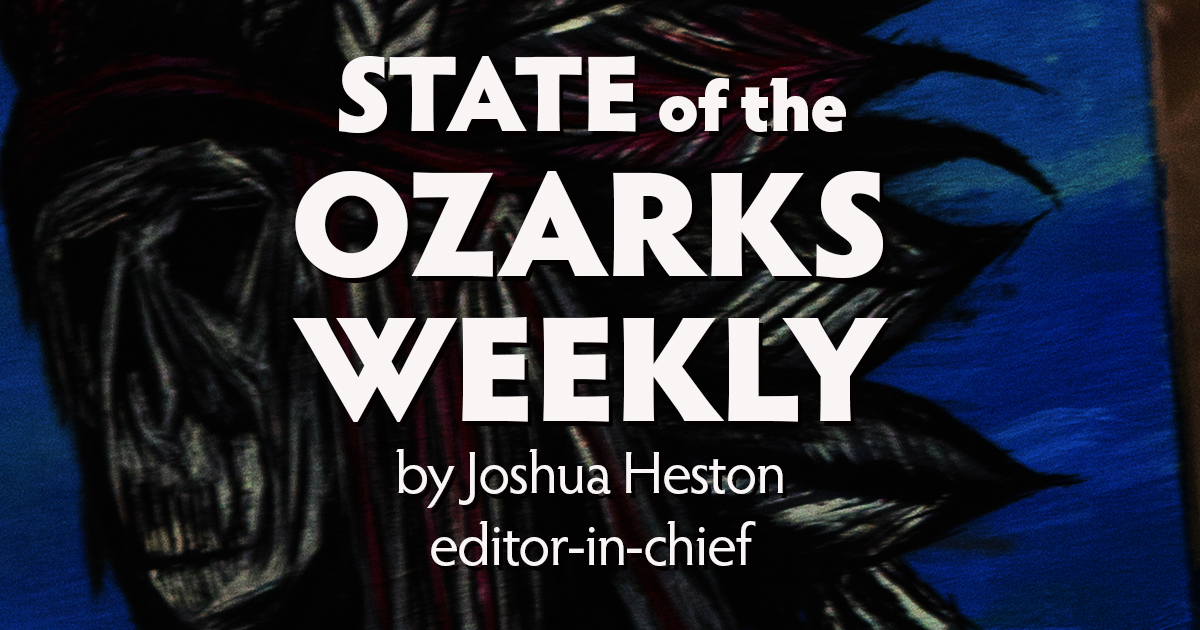
Artwork by Clint Loveland, February 25, 2017.
BEEN THINKIN’ ABOUT… STORIES TO TELL. Leaning back in my chair at Vintage Paris Coffee, I close my eyes, listening to the stories being spun and woven by the small group of dedicated writers around me. There is an oaky bitterness in the air, but only because I have my nose in a mostly emptied glass of Old Rasputin Russian Imperial Stout. StateoftheOzarks Writers Round is a new development, begun only this year, but the traditions are old, even if my ambitions aren’t terribly lofty. I just love being around writers, being around writers I trust, and getting to savor moments of hearty storytelling. In a world of reels and elevator pitches, this kind of thing is a relief. But storytelling comes in many forms.
“And then these huge machines called Imperial Walkers came across the snow and the rebels started fighting. Luke got into a snow speeder and led other pilots in snow speeders and they kept getting shot down. Luke’s snow speeder was shot down but he made it out…” My older sister had gone to see The Empire Strikes Back the night before and was retelling me the film. The year was 1980. I was in my high chair in the kitchen, two years old, placing my fingers into an apex, fingertips evenly touching. The florescent light above the double oven — later replaced with a pantry — was bright, the greenish light washing across the 1960s’ era light green tile above the counters. The refrigerator hummed. People don’t believe my memories, the memories of a random two-year old, but the memories are there, nonetheless, and that story changed my life. Star Wars, one of the great stories of the 20th century, shaped my perception from that moment on.
The Christmas tree lights are blinking on the little artificial tree next to the fireplace that never got used at Grandpa and Grandma’s. Stacks of gifts surround the glossy 1950s’ era end table. The gray carpet is soft and grandpa’s voice is old and strong and harsh and calming, like always. I miss his voice the most, his stories second. His was a man’s voice, a farmer’s voice, a cowboy’s voice, a carpenter’s voice, but — for me, most of all — my grandpa’s voice. He sat in his big high-backed brown easy chair that creaked, almost a throne of sorts, halo made of the light from a single 90-watt light bulb on a wooden lamp stand. I assume there was supposed to be a shield for the light bulb but grandpa took it off to make his reading light brighter. He was always reading, always telling stories, often of his time as a cowboy in the Dakotas, of things like rye harvests and cowboy bunks and winter nights too cold to really describe. My favorite was the story of the big rodeo at the medicine rocks, of a strange and huge footprint embedded in the stone on one side of the natural amphitheater — and of a corresponding footprint embedded across the vast gap on the other rock. Did a huge man step across the span in some lost age? We won’t know. The dam built on the Missouri River covered it all in deep Dakota water. But grandpa’s memory of the buffalo roast still remains. “They would roast the whole buffalo,” he was saying, “and you had to time when you got in line. The outside was burnt up, and the inside was raw, so you wanted to get in line at the right time to get the meat that was good.”
Storytelling lineage runs long. Perhaps it is indeed the Welsh blood, the Welsh long known for stories and song and for having all but lost their land to the English. My own Welsh ancestors gave up on England a long time ago, landing in North Carolina in 1721 and thus giving me a proud but typically unused American title as well as a perhaps-now-rational explanation for my not-so-rational love of stories and song. Perhaps that’s why I love Halloween so much, not just because Halloween is the quintessential Celtic holiday but because ghost stories make the best stories after all.
“Me and Jeanie and Alden and Connie and Esther and Butch would all walk up the road and cross the bridge and then double back and go down through the trees to the old house that sat back in the timber,” my mom was saying. She was only nine at the time. Most of the rest of them were younger. A little passel of Iowa kids, kids who wouldn’t be let outside the yard these days, not without supervision. But it was 1949 and they were going hunting for ghosts, waiting for real darkness to fall before going to John Alterman’s house to look for him in case he showed up. My mom’s ghost stories were the best and she told them to me with the lights out as I was ready to fall asleep, her voice soft, indescribable but impossible to quite forget, and also yet still with her father’s gravitas. Their ghost hunts were not without reason. The abandoned house back up in the dark woods was indeed John Alterman’s house and no one lived there, not after John had been found dead, shot in the back of the head as he sat in his chair. Someone had laid him out with his head in a bread pan so his blood wouldn’t stain the old wooden floor. The story is horrifying but my mom, her sister, her cousins, never did find his ghost. Truth is, kids are more resilient, more resourceful, more intelligent than we give them credit for. And my mom’s ghost stories were the best. No matter how scary, there were always warm blankets, warm love, and in the morning, the sun yet rose on another day.
I lean back again in my chair, again in the present. Grandpa has been gone almost 20 years. My mom also gone, some 14 years. I miss them both, terribly. But their voices, their lives, live on in my head, most especially their stories. And perhaps not so strangely, to me they will never be ghosts, never be lost in some strange space between. Instead, they are still alive, still very present, still never quite so far off, now that the shock and grief has worn off. And they — as many of the rest of my ancestors — are there, always, to remind me there is no reason to fear the dark, so long as there yet are stories to tell.
— Joshua Heston, editor-in-chief, StateoftheOzarks
© StateoftheOzarks 2025